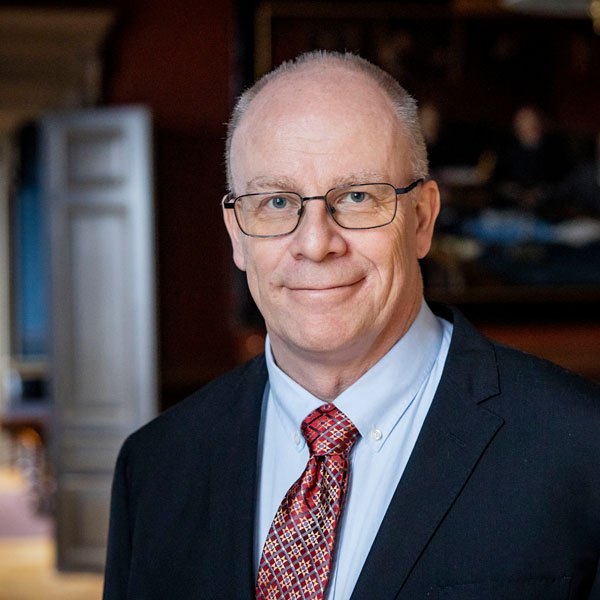
First and foremost: welcome to a new semester! It’s always exciting to see the new students who have arrived in town – passing cheerful students in their best clothes, getting to know one another in our fantastic Uppsala. I hope we’ll have a fun and educational semester in which reflection and good conversation are combined with success and breakthroughs.
For me, as Vice-Chancellor, the semester has started, as usual, with start-up meetings with management teams of various shapes and sizes. One of the semester’s first meetings was with the Adviser to the Vice-Chancellor on Equal Opportunities, professor Åsa Cajander, who discussed her work on rights and opportunities for us all.
I believe it is important for everybody to think more about how we take care of each other, how we work together and what kind of culture we have – in units, groups, departments…
If we are to be at the forefront, we also need to be open to the world – to the different and the special, the unaccustomed and challenging. Uppsala University needs to be characterised by curiosity. This is the only way we can become what we want to be and there can be no doubt that equal opportunities are a decisive issue for Uppsala University. This is a matter not only of everybody’s rights and opportunities but also of the quality of our research and education. I have therefore asked Åsa Cajander to write about why these issues are particularly relevant just now and how we can continue to develop this work at the university.
____________________________________________________________
Here follows Åsa Cajander’s text:
Equal opportunities are not a side issue but a precondition for quality, academic freedom and excellence.
Many different issues fall under the heading of equal opportunities. These may include gender equality and accessibility, opportunities for students, international staff, career paths or our academic culture. What they all have in common is that they are issues that affect people’s ability to participate in the University’s activities on equal terms.
Equal opportunities are currently more controversial and polarised than they have been for many years. In a number of countries, initiatives for gender equality, diversity and inclusion are being questioned, at the same time as intolerance of differences seems to be increasing. This tougher social climate does not stop at the University’s doors. Researchers and students are being subjected to threats, hatred and harassment. This can lead people to withdraw from public and academic discourse and to avoid certain research issues, discussions and critical perspectives. It can even lead to issues and concepts being banned or described as ‘bad research’. Ultimately, this is a threat to academic freedom and the University’s task of developing and disseminating research-based knowledge.
The rapid development of artificial intelligence (AI) is making these issues even more pressing. AI may lead to increased accessibility and may create new possibilities in research and education. However, quite apart from access to AI perhaps being uneven, the technology may also reproduce discriminatory patterns, for example in recruitment, admission, examination and student support. AI can be used to rapidly spread false claims, manipulated images and large amounts of threatening or offensive messages.
This poses new challenges for the University. We need to safeguard open academic discourse and the critical pursuit of knowledge, at the same time as we create environments where people feel safe enough to participate and where they can ask for help if they feel they are being harassed. It is important to remember why we work on these issues. Equal opportunities are a matter of rights for the individual but also of quality for the University. Safe and inclusive environments give people the opportunity to contribute fully to research and education. In addition, academic freedom requires environments in which people are unafraid to think, talk, question and participate. And neither should equal opportunities be seen as a side issue in the pursuit of excellence. If it is to attract, develop and retain top talents, the University has to make sure that their knowledge can be put to use without unnecessary obstacles.
Much is already being done at Uppsala University, and many members of staff and students are engaged in this work. There are also areas in which more work is needed. For one thing, we need to continue to develop our work on inclusion in teaching environments and to provide support to an increasing number of students with different needs. We also need to create the right conditions for our many international members of staff and students to participate, develop and contribute to the full extent of their abilities. International members of staff are vital to the University’s research and education but are still facing language and other barriers that restrict their participation and opportunities for professional development. International recruitment is not enough. We also need to make sure that those coming here get real opportunities to contribute, grow and pursue academic careers.
Our work on equal opportunities needs to be constantly built up, monitored and nourished over time. If we succeed, we will not only create a more inclusive University. We will also strengthen the quality of our research and education and thereby Uppsala University as a whole.
Åsa Cajander
Adviser to the Vice-Chancellor on Equal Opportunities